Discover the Benefits of Non-Stick Coatings
Struggling with baked-on residue and spending a small fortune on release agents? Or finding it difficult to remove baked goods from moulds, leading to unnecessary waste? If you are looking for equipment designed for demanding applications, consider baking trays and moulds with a non-stick coating. What are the key advantages?
- resistant to high and low temperatures, UV radiation and chemical exposure;
- very low friction coefficient, preventing dough from sticking or tearing when removed;
- improved production efficiency – no need for release agents, with reduced cleaning time and lower maintenance costs;
- certified and approved for food contact;
- consistent, high-quality baking results – better dough rise, even crust formation and uniform crispness.
Types of Non-Stick Coatings
We offer several types of non-stick surfaces for trays and moulds, each available on request. You can choose between silicone coatings – SiliRex (30–50 µm, red, 1,000–1,500 baking cycles) and ResiRex (20–30 µm, transparent, 1,000–1,500 baking cycles) – and fluoropolymer coatings, including:
- PoliRex Eco – 20–25 µm, black, 500–1,000 baking cycles;
- PoliRex Opti – 20–30 µm, black metallic, 1,000–2,000 baking cycles;
- PoliRex Profi – 40–60 µm, green or black, 2,000–3,000 baking cycles;
- PoliRex Special – 60–80 µm, red, up to 3,000 baking cycles.
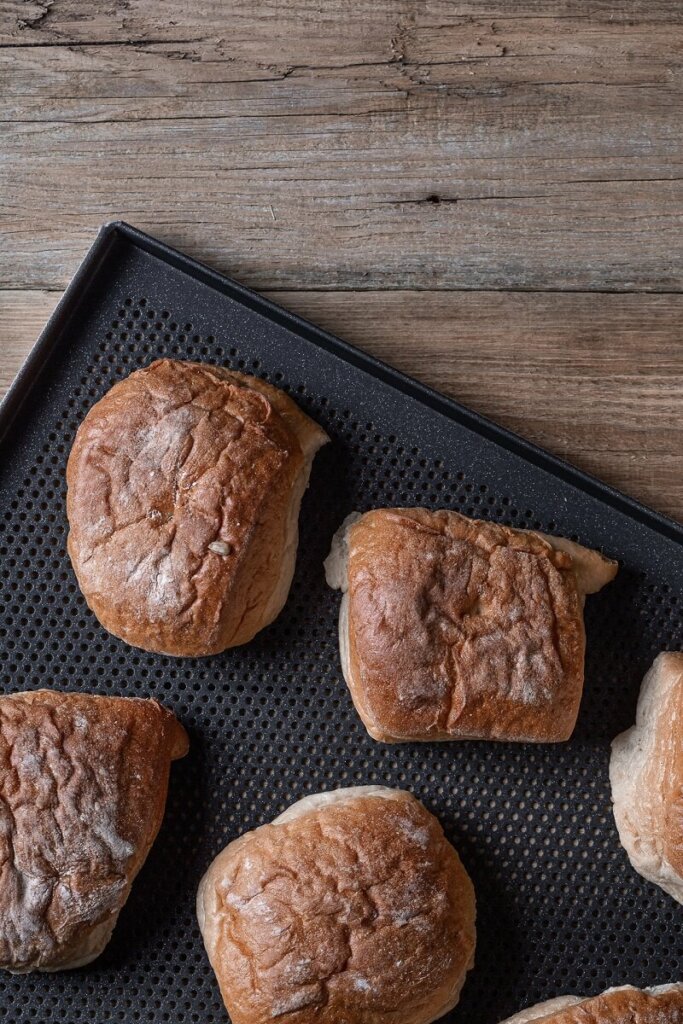
Non-Stick Baking Trays – Before First Use
How should you prepare non-stick baking trays for use? Proper initial seasoning is essential. For metal bakery and confectionery equipment, the process involves heating the trays in the oven for approximately 45–60 minutes at 80–100°C. After heating, the working surface should be lightly coated with vegetable oil and left to cool at room temperature.
Please note that silicone-coated products also require heat treatment, but under different conditions – either 60 minutes at 250°C or 4 hours at 200°C. If you are using trays with PoliRex Green or PoliRex Black coatings, you can start using them straight away, as these surfaces do not require initial seasoning.

Cleaning Bakery and Confectionery Equipment
Stubborn residue, food waste and build-up are everyday challenges. Keeping bakery and confectionery equipment clean is essential. That is why the MAGOREX range includes specialised products and accessories designed to simplify cleaning and maintenance.
One of them is a universal tray cleaning machine, developed specifically for production environments. It effectively removes flour, seeds and small dough residues after baking. The machine is equipped with interchangeable brushes of varying stiffness, allowing it to be adapted to different needs. This makes it highly versatile and suitable for cleaning various types of trays, including those with Teflon coatings.
Looking for additional solutions to tackle baked-on residue? We also offer a dedicated HAEM cleaning liquid – available in liquid form (for trays and moulds) and gel form (for bakery racks).
Cleaning Non-Stick Accessories
You can clean them as often as needed – just follow a few simple guidelines. Non-stick accessories do not require harsh abrasive agents or stiff brushes. Avoid cleaning products that are not suitable for this type of surface, as they may shorten the lifespan of the equipment.
How should you care for non-stick trays and moulds? A simple three-step method works best:
- gently wipe soiled areas with a soft sponge and warm water,
- shake off excess water from the tray or mould,
- allow them to air dry or place in an open oven for 15–20 minutes at 150°C.
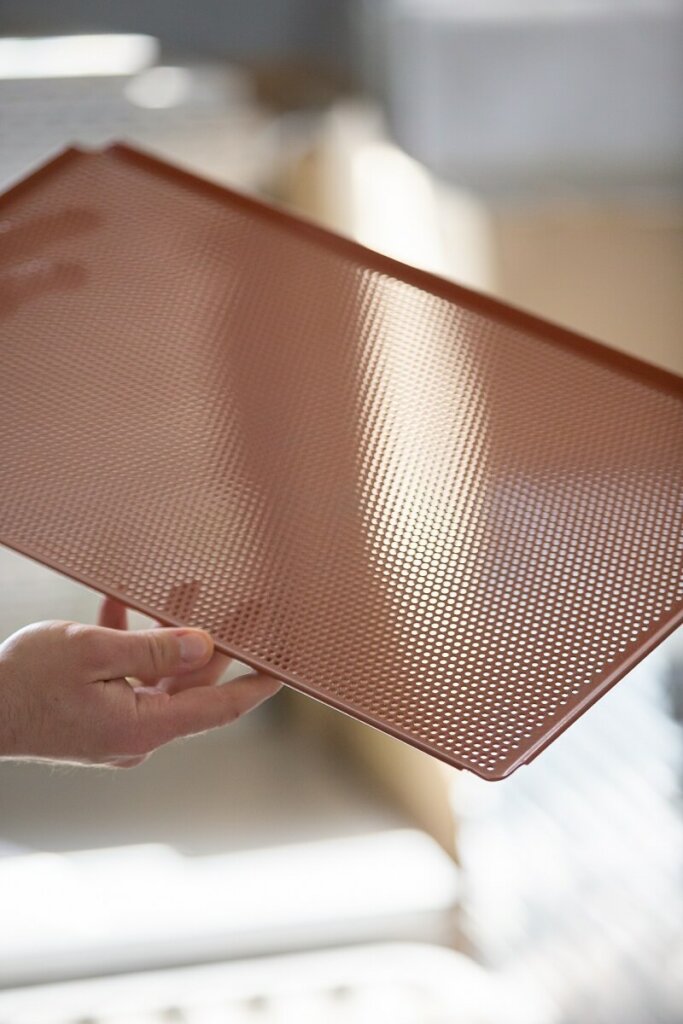

Basic Guidelines for Using Non-Stick Coatings
How should you care for non-stick baking trays and moulds? Follow these key principles to make the most of their performance:
- trays and moulds should never be heated empty – this significantly reduces coating lifespan;
- avoid cutting directly on the surface or using sharp tools such as knives, scrapers or metal spatulas that may damage the coating;
- ensure the coating is completely dry before baking – otherwise, the dough may stick and damage the surface;
- store trays and moulds carefully to prevent mechanical damage;
- the number of baking cycles depends on the type of products being baked – the coating reaches the end of its lifespan when dough begins to stick;
- proper handling and gentle cleaning can significantly extend its durability;
maintain stable humidity levels in the proofing chamber.
Discover the advantages of pressed baking moulds from Magorex →
Recoating – Regeneration of Non-Stick Coatings
At MAGOREX, we continuously strive to offer solutions that bring real value to bakeries and confectioneries. That is why we provide a dedicated service for customers whose non-stick trays and moulds require renewal. Worried that worn equipment needs to be replaced? Not necessarily – our recoating service offers a practical alternative.
We remove the worn coating mechanically or thermally and carry out minor repairs if needed. The process is completed with the application of a brand-new coating, restoring your equipment to excellent condition. What is more, this process can be repeated multiple times.