
The influence of the mould on the "form" of your bread
We decided to find out and check whether the long-term observations of Magorex experts will be confirmed in research. That is why we commissioned tests to finally determine whether the material from which the mould is made affects the quality of the bread. Are there differences in the degree of baking the crust, or does practice make perfect and a good specialist will bake the bread evenly in any form? Are the differences so significant that it is worth “paying extra” for a mould made of a more modern material? Or maybe a certain type of form is the Holy Grail of baking?
Types of forms selected for the test
In order to finally find out what the facts say, Magorex commissioned baking tests from an independent subject – the Institute of Bakery in the Netherlands. Moulds made of the most popular materials from our offer were subjected to the test. Each material was tested in two variants: in the original, “raw” version and in a version enriched with an outer layer of special black paint that increases thermal conductivity. The following forms were selected for testing:
- 1.2 mm thick aluminum,
- acid-resistant stainless steel, 0.8 mm thick,
- aluminized steel (Alusteel), 0.75 mm thick – bent version,
- aluminized steel (Alusteel), 0.9 mm thick – pressed version.
Equal opportunities, i.e. the same conditions and the same recipe
Each bread was baked under identical conditions. The moulds were placed in a HEIN batch oven for exactly 35 minutes at 210-280°C with a one-second burst of steam. Each mould contained the same grammage and flour mixture from which the wheat toast bread was baked.
Test results - Aluminum
Baking moulds made of aluminium are characterized by very good thermal conductivity. Another advantage of this material is its lightness. It is also an ecological material because even despite repeated recycling, it will not lose its properties and structure. However, aluminium is not an ideal material, because it is not long-lived – its service life is inferior to other materials, and the material is susceptible to mechanical damage.
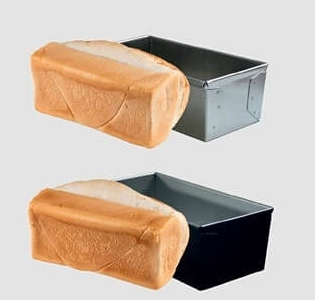
How did the loaf bake in the aluminium mould turn out? The bread is even and nicely baked. The use of black paint on the exterior only enhanced this effect: the loaf was even, but clearly more baked.
Tip: We recommend shortening the baking time or lowering the temperature so that the bread is not too browned.

Acid-proof stainless steel
Forms made of acid-resistant stainless steel are durable, and resistant to corrosion and any mechanical damage. They are less popular than aluminium but still have their supporters. How did they fare in the tests?
The loaves taken out of this type of mould did not have a uniform colour. You can see a big difference between the sides of the bread, which was definitely lighter than the well-baked bottom.
A steel mould painted with black paint repeated this effect, but the sides took on the right colour and the bottom was too baked.
Tip: It is worth shortening the baking time or lowering the temperature, but in a stainless steel mould it is not possible to achieve a uniform degree of baking.
Aluminized steel - Alusteel
This material is by far the most popular among our customers. Alusteel are moulds made of carbon steel coated on both sides with aluminium. This type of form is highly resistant to mechanical damage and constant heating and cooling. It also shows increased corrosion resistance. In the event of damage to the surface coating, the active ingredients of Alsteel spontaneously form a passive, protective anti-corrosion layer. This is a material that we often recommend to customers.
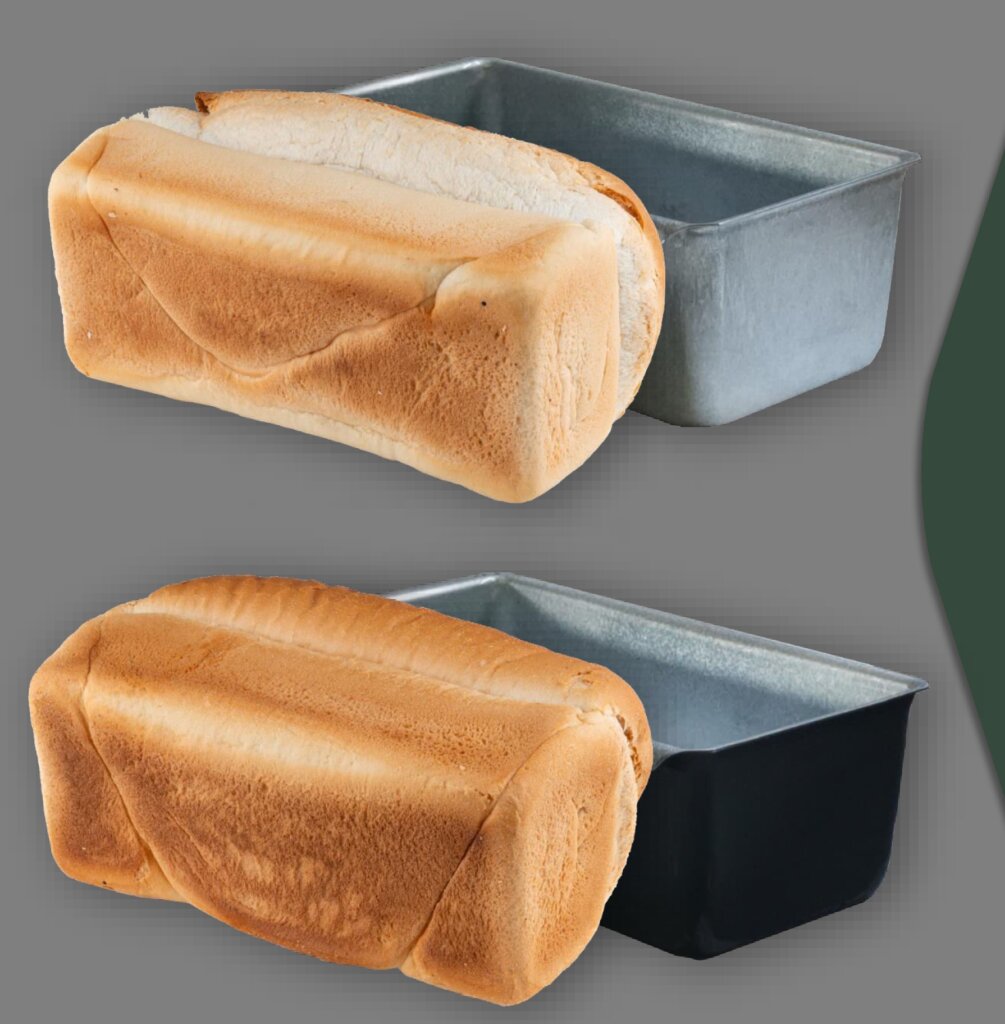
Both bread baked in the bent and welded form, as well as in the pressed form, had an even degree of baking on the entire loaf. The test of moulds painted externally in black was equally positive. The bread was baked evenly, but the crust turned out to be too baked.
Tip: We recommend lowering the temperature or shortening the baking time.

Form matters
Do you want to bake cleverly, i.e. economically?
Equipping your bakery with moulds enriched with black paint will shorten the baking time and reduce production costs. With the regular use of black-painted Alusteel moulds, our customers can reduce their electricity costs by up to 10%. In Poland, this information was confirmed by, among others, the company Benus, which uses 800 sets of Alusteel, externally painted black, which we produce, which work on the production line every day.
Are you looking for more ideas for saving money in your business? Read the tips we have for you! →
But which form will be best for me?
The tests have clearly shown that the material from which the mould is made is important and affects the parameters of the bread. The type of material translates into the final colour, the evenness of baking the crust, and even the baking time. When equipping your bakery, however, it is also worth remembering about such issues as durability, resistance to damage and corrosion of the material. Choosing the best form for your business is more important the more often you will use them. It is worth making purchasing decisions based on all factors and consciously, taking into account your individual needs.
Do you need advice from an experienced manufacturer of baking equipment? 30 years of experience and a team of trusted experts in contact with our Partners will dispel all your doubts. Find out and get in touch today! →