
To begin with – keeping your trays and moulds in the best possible condition requires proper handling. When working with non-stick coatings, correct usage is essential. That is why we strongly recommend thorough training for all staff who operate your bakery or confectionery equipment.
If you already use trays or moulds with anti-adhesive coatings – also known as non-stick or Teflon coatings – we have good news: they can be professionally regenerated. If you are considering purchasing them, it is worth noting that, in addition to being regenerable, these coatings are designed for demanding applications. They help reduce food waste, limit the use of release agents and eliminate the common issue of baked goods sticking to the mould.
Coincidence Breeds Inventions
Revolutionary inventions often came about by chance. It was the same with non-stick coatings. In 1938, the American chemist Roy Plunkett, while working on cooling agents, discovered that the material he created was extremely heat and chemical resistant. 20 years later, Teflon, as he called it, was appreciated by many industries, including food. Why? The secret lies in the properties of the material.
Advantages of Anti-Adhesive (Non-Stick) Coatings:
- Thermal resistance – suitable for both high and low temperatures, as well as resistant to UV radiation and chemical exposure,
- Non-stick and corrosion-resistant properties – increasing production efficiency while reducing costs, eliminating the need for release agents and lowering cleaning and maintenance expenses,
- Physiological neutrality – approved for food contact; Magorex uses coatings with fully documented and certified origin,
- Low friction coefficient – preventing dough from sticking or tearing when removed from the mould,
- Consistent, high-quality baking results – supporting proper dough rise, even crust formation and uniform browning with the desired crispness,
- Regeneration possibility – allowing the removal of the worn coating and application of a new one, helping to optimise long-term operating costs.
Learn more about the materials used in Magorex products →

Recoating – Teflon Regeneration
Have your trays and moulds lost their original performance? Considering replacement, but postponing major investment? This is the right time to consider professional regeneration.
The recoating process involves mechanical or thermal removal of the worn coating. If necessary, we also carry out minor repairs. The final step is the application of a completely new coating, restoring your equipment to excellent condition – often described by our customers as a true “like new” effect. Importantly, this process can be repeated several times.
The cost of regeneration ranges from 30% to a maximum of 40% of the price of a new product.
Upon request, we can additionally apply a black coating, which shortens baking time by up to 8% and ensures more even browning. If you are concerned that damaged equipment needs to be replaced, consult with us first. Call or contact our experts for professional advice.
Types of Non-Stick Coatings
We offer several types of non-stick coatings for trays and moulds. Each option is available on request and tailored to your specific needs.
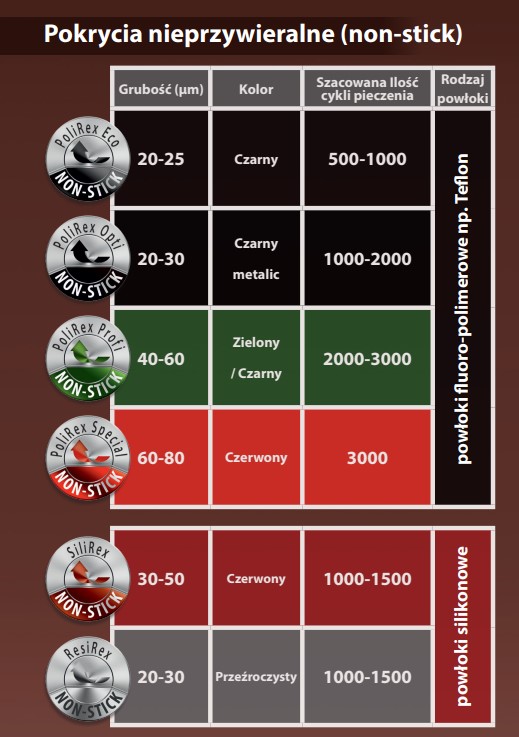
You can choose from the following silicone coatings:
- SiliRex – thickness 30–50 µm, red, estimated lifespan of 1,000–1,500 baking cycles,
- ResiRex – thickness 20–30 µm, transparent, estimated lifespan of 1,000–1,500 baking cycles.
Silicone coatings perform optimally for up to 1,500 baking cycles. They are particularly well suited for products with high sugar and protein content.
You can also select fluoropolymer (Teflon) coatings, which we offer with regeneration options:
- PoliRex Eco – thickness 20–25 µm, black, estimated 500–1,000 baking cycles;
- PoliRex Opti – thickness 20–30 µm, black metallic, estimated 1,000–2,000 baking cycles;
- PoliRex Profi – thickness 40–60 µm, available in green or black, estimated 2,000–3,000 baking cycles;
- PoliRex Special – thickness 60–80 µm, red, estimated up to 3,000 baking cycles.
Teflon coatings offer extended durability and, depending on the selected type, maintain their properties for approximately 500 to 3,000 baking cycles. At Magorex, we also provide professional recoating services, helping you significantly reduce long-term operating costs.
Back to Basics – Golden Rules of Use
How can you ensure that your trays retain their properties for as long as possible? Here are a few essential guidelines to help you make the most of their performance and extend their service life:
- Avoid cutting directly on the coating or using sharp tools – handle spatulas, knives, scrapers and other utensils with care to prevent surface damage.
- Do not heat empty trays or moulds – this significantly reduces the lifespan of the coating.
- Store carefully – protect the surface from scratches and mechanical damage.
- Maintain stable humidity levels in the proofing chamber – this helps preserve the coating in good condition.
- Ensure moulds are dry and cooled before use – otherwise, dough may stick and damage the surface. For best results, dry moulds upside down and allow them to air dry naturally.
Please note that the number of baking cycles achieved with non-stick coatings also depends on the type of products being baked.
And how should they be cleaned to maintain their full performance? A simple three-step method delivers the best results.

Three-Step Cleaning Process for Non-Stick Accessories
For equipment with non-stick coatings, a simple three-step method works best:
- Gently wipe soiled areas with a soft sponge and warm water.
- Shake off excess water from the tray or mould.
- Allow the equipment to air dry or place it in an open oven for 15–20 minutes at 150°C.
Discover the effectiveness of HAEM cleaning liquid →
Here’s to Long-Lasting Performance!
The valuable properties of non-stick coatings come with a defined lifespan. A clear sign of wear is when dough begins to stick to the surface. However, this process can be significantly delayed through proper handling, careful cleaning and a good usage culture. It is also worth remembering the option of professional recoating, which helps reduce costs and gives your trays and moulds a second – or even third – life.