What Happens to a Baking Tray When It Is Exposed to Heat?
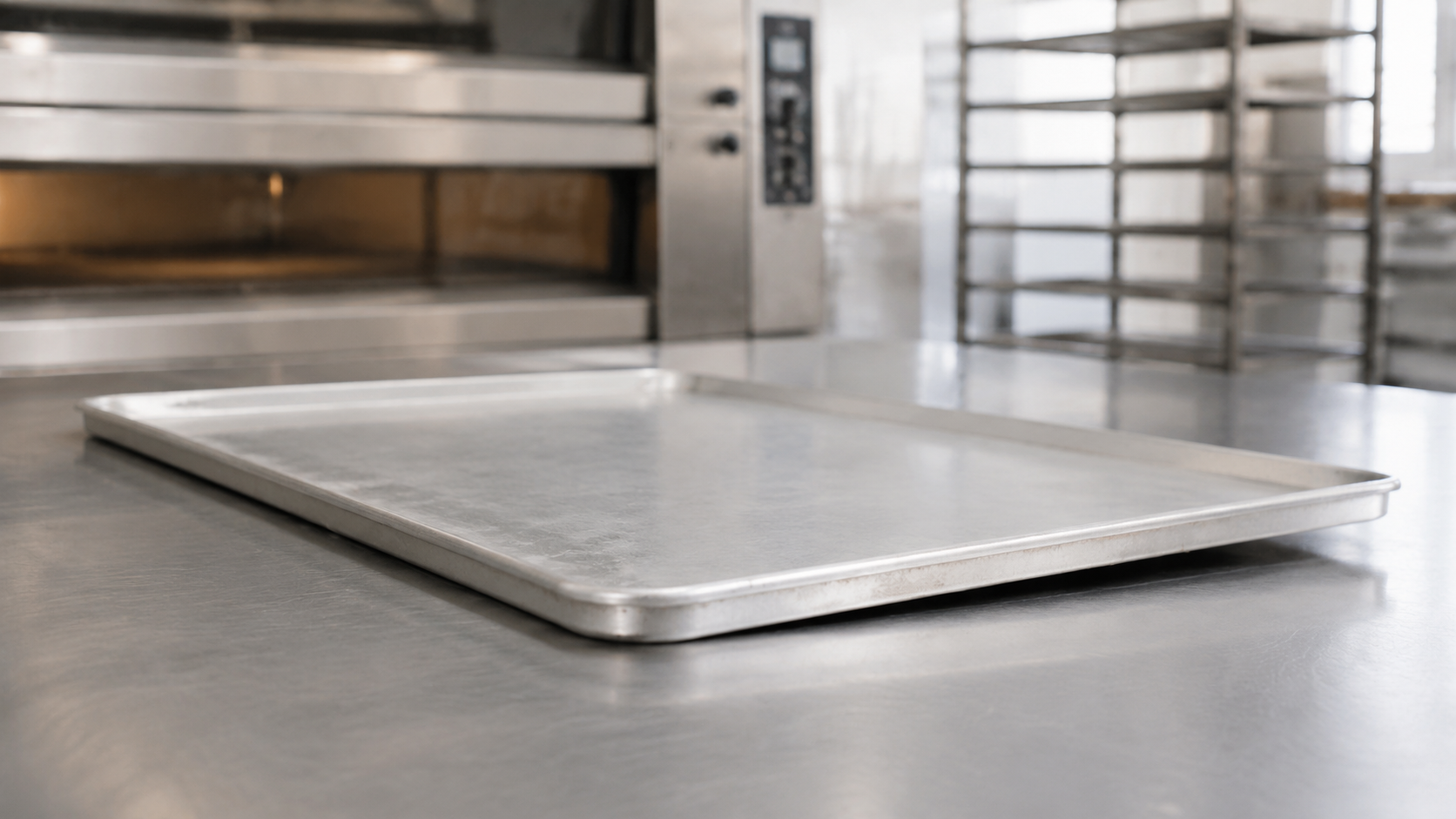
Metal expands as it heats up and contracts as it cools. If the entire surface of a baking tray changes temperature at a similar rate, the material can return freely to its original shape. Problems arise when one section heats up or cools down much faster than the rest.
This creates thermal stress within the material. When temperature differences are significant or repeatedly occur over time, the tray may buckle and eventually become permanently deformed.
Slight bending that appears only while the tray is heating does not necessarily indicate damage. However, deformation should be investigated if it remains after the tray has cooled completely, prevents it from sitting securely on the rack runners or affects baking results.
What Are the Most Common Causes of Baking Tray Deformation?
- Uneven heating
Local temperature differences may result from the way the oven operates, uneven product distribution or repeatedly using the hottest level of the oven rack. Cleanliness also matters. On perforated baking trays, carbon deposits can block the holes and restrict the flow of hot air, altering baking conditions. - Rapid cooling
Placing a very hot baking tray in cold water causes the metal to contract quickly and unevenly. After removing the tray from the oven, it is therefore best to let it cool at room temperature before cleaning it in accordance with the recommendations for the specific material and coating. - Mechanical damage
Temperature is not responsible for every deformation. Dropping trays, striking them against a rack, forcing them into incorrectly sized runners or storing them improperly can alter the geometry of their sides. These formed sides play an important role in maintaining the rigidity of the entire tray. - A tray that is not suited to the process
A tray’s performance is determined not only by its thickness, but also by its material, dimensions, side construction, perforation, load and support points. The principle that “the thicker the tray, the better” is therefore an oversimplification—particularly when comparing different materials.
Depending on the model, Magorex perforated aluminium baking trays are available in thicknesses of 1.5 or 2.0 mm. Pressed aluminium baking trays have a thickness of 1.35 mm, while the AluSteel baking trays presented in the catalogue are 0.75 mm thick. These values should not be compared without taking the construction and properties of each material into account.
Aluminium or AluSteel?
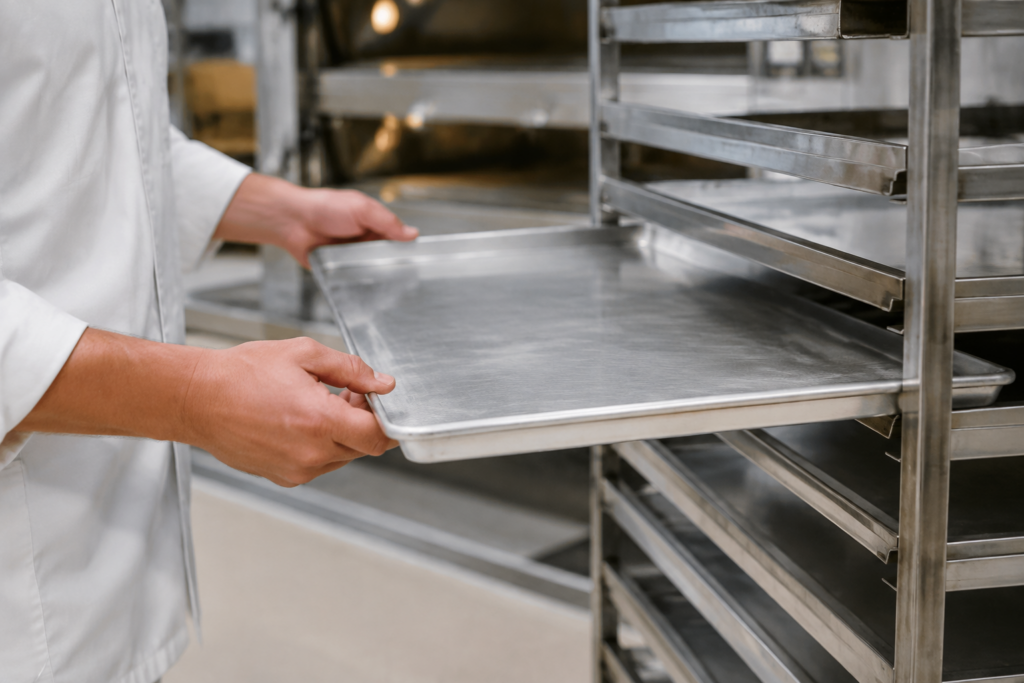
There is no single material that is best for every application. Aluminium is lightweight and conducts heat efficiently. At Magorex, we manufacture solid aluminium baking trays as well as trays with 2, 3 or 5 mm perforations, available with different side configurations and in a wide range of sizes. Other configurations, non-stick coatings and reinforcement with a stainless-steel rod are also available on request.
AluSteel consists of a steel core coated on both sides with a 20 µm layer of aluminium. The steel core provides rigidity, while the aluminium protects the surface. The material is resistant to deformation caused by exposure to high temperatures and repeated heating and cooling cycles.
The choice should take into account the type of product, oven model, operating temperature, number of cycles, load weight and cleaning method. Only by considering all these factors can the right solution be selected for actual production conditions.
How Can the Risk of Deformation Be Reduced?
- allow the tray to cool before washing it;
- do not cool it with cold water or a wet cloth;
- remove carbon deposits regularly and keep perforations clear;
- do not drop trays or strike them against rack runners;
- check whether the problem repeatedly occurs at a particular oven level;
- distribute the product load evenly;
- select the material and construction according to production intensity.
When Should a Baking Tray Be Taken Out of Service?
A tray should be inspected if it continues to rock after cooling, no longer rests securely on the runners, makes loading unsafe or affects baking quality. Cracks, sharp edges and visibly deformed sides are also reasons to withdraw it from use.
If the problem keeps recurring, inspect not only the tray but also the runners, rack and temperature distribution inside the oven. Replacing the tray without identifying the underlying cause may result in the same deformation happening again.
The Right Baking Tray Helps Deliver Consistent Results
At Magorex, we manufacture standard baking trays as well as customised solutions in a range of materials. Our trays can be solid or perforated and are available with different side configurations and additional reinforcement. The aim is not to choose the “strongest” tray, but the one best suited to the specific production process.
Looking for baking trays suited to your oven and production requirements? Explore Magorex solutions or contact our team. Information about the oven model, runner dimensions, product type and number of baking cycles will help us recommend the right material and construction.
Frequently Asked Questions
Can a Hot Baking Tray Be Washed with Cold Water?
This is not recommended. Rapid cooling causes the material to contract unevenly and increases thermal stress. It is safer to wait until the tray has cooled.
Is a Thicker Baking Tray Always Less Likely to Warp?
Not necessarily. Thickness affects rigidity, but the material, dimensions, side construction, perforation, support points and load are also important. Trays made from different materials should not be compared solely on the basis of thickness.
Does Perforation Make a Baking Tray Weaker?
Perforation changes the tray’s construction, but it does not determine its durability on its own. The diameter and pattern of the holes should be selected according to the tray’s dimensions, thickness, side construction, intended product and load.
This article was prepared by the Magorex team, a manufacturer of professional equipment for bakeries and pastry shops. Discover more solutions designed to support modern baking professionals at www.magorex.pl.